Thursday, March 19

Blossoms on Water


The Cherry Blossom set contains three individual flowers that are perfect for creating CAS style cards. I stamped each of the images in the bottom corner of a kraft coloured card base, and set to work with my coloured pencils.


To give the impression that the flowers are floating on water, I added a thick shadow beneath each one. This gives the illusion of depth.


Adding "ripples" gives the impression of movement, like little wavelets radiating out from each blossom as it moves on the surface of the water. To add the ripples, I started on the very tip of my brush marker and then pressed down as I made the stroke, before coming up to the tip again. It's a stroke that needs a bit of practise, but is perfect for creating waves.


Stamps and Dies:
  

Tuesday, March 17

Jackie's Flower Garden


I'm delighted to share a collection of gorgeous cards created by the lovely Jackie Trinder, including a wonderful floral wreath that she constructed with the individual flowers from the Cherry Blossom set. Happily for us, Jackie has generously included a colour chart with each of her projects to help inspire our own colour selections.


Sunday, March 15

Everything Papercraft - Tearing


 Rip, shred, tear… that’s right, it’s a technique!

Although there are actual tools to create “straight” tears, it’s not difficult to rip your paper in the shape you want by using a simple little trick.  Take a paintbrush loaded with clean water and “paint” where you want the paper to tear.  Allow the water to soak into the paper for a few seconds and then gently tear along the wet line.  You will have all the texture of a tear but with the control you’re after!

Paper tearing is one of the methods of paper distressing used to give your cards and paper craft projects a vintage or rustic look.  Add some ink to the torn edge and you will have a whole other dimension of interest to your project. Similarly, if you choose coloured paper or card stock with a white core, you’ll end up with a torn white line that contrasts with the rest of the paper.


Friday, March 13

Judy's Cherry Blossoms


Judy is sharing an absolutely beautiful Cherry Blossom gift set with us today, and she has kindly included a colour guide for those who would like to have a go at colouring in a similar style. The set includes a gift bag, handmade card and a matching tag, which is sure to delight the lucky recipient. 


Here are some close up photos of each element in the set. As you can see, Judy has used the individual blossoms to create a beautiful background for the hand made card. And don't you just love the matching cardstock she chose? Gorgeous!


Wednesday, March 11

Tutorial - Diagonal Gatefold Card


A nice simple fold that adds a little more interest to an old favourite. Diagonal Gatefold cards are easy to create and can be decorated for lots of different occasions. It's fairly simple to alter the dimensions to suit your needs, but be mindful of the overall size of the card if you want it to fit into a standard envelope.


1. Place a 93/4" x 51/2" piece of card stock horizontally on your score board and score at 31/4" and 61/2" to make three panels.


2. Score the first panel diagonally from the top of the first score line to the bottom left corner of the card stock. Then score the third panel diagonally from the top right hand corner of the card stock to the bottom of the second score line (see the template above for score line placement).


3. Fold and burnish along all the score lines - the vertical folds are valleys and the diagonal folds are mountains. Fold the sides of the card in to form the base.


4. To decorate, cut two pieces of coordinating paper measuring 51/4" x 3". Now cut each in half again on the diagonal so you have four long triangles. Adhere them with double sided tape or glue to the front of the folded card as shown in the photos below.


5. Decorate the front of the card as desired. I have stamped, coloured and fussy cut some flower images that I will adhere to one side of the card opening. Take care not to glue the card closed by securing images or embellishments on both sides of the opening.


6. When the card is opened, the embellishments will be visible from the inside. Be aware that they will rotate slightly, so take that into consideration when placing your items.


7. I am going to stamp my sentiment in the area where I'm pointing. It will not be visible when the card is opened, so again, take this into consideration when decorating.


It's a lovely, simple card that still has that "wow" factor. Enjoy!

Stamps:

Tuesday, March 10

Hot Tip Tuesday


Today's quick tip is for those who love to make shaker cards.
Whether you fill your shaker with seed beads, pearls or sequins, glue a few to the background so that they're always visible, even when the remaining items have fallen to the bottom of the window. Not only will you always have a little sparkle whatever way you card is positioned, but the items that are glued in place will often catch others creating an ever changing scene.


Sunday, March 8

Heaven's Precious Light

If you were wondering what became of the night time scene I coloured a couple of days ago... wonder no more! Coupled with one of the sentiments from the digital set, it has made a lovely Christmas card. 


Stamps:

Saturday, March 7

Mother and Bub

My favourite part of this image is the cute expression on the baby koala's face. With his chin resting comfortably on Mum's head, he looks like he doesn't have a care in the world!


Stamps:

Friday, March 6

Tutorial - Colouring a Night Scene


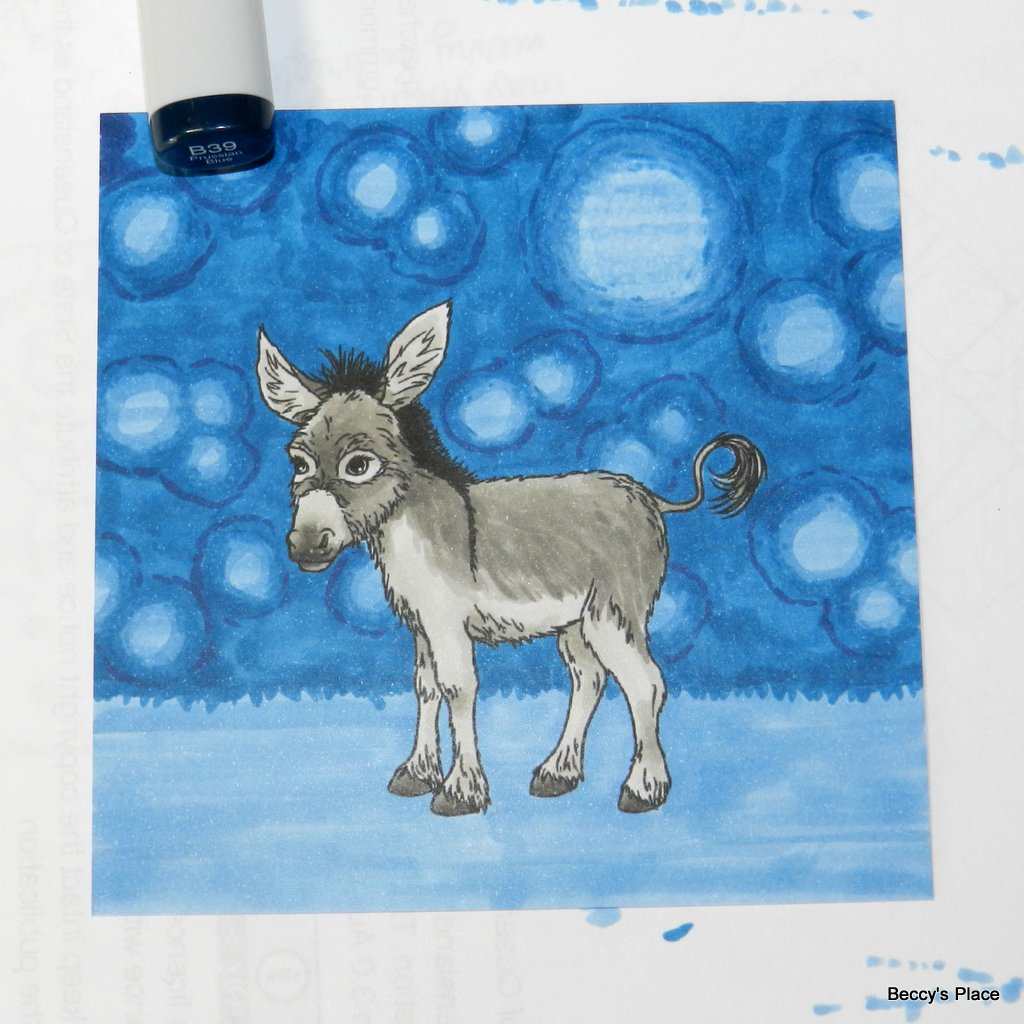
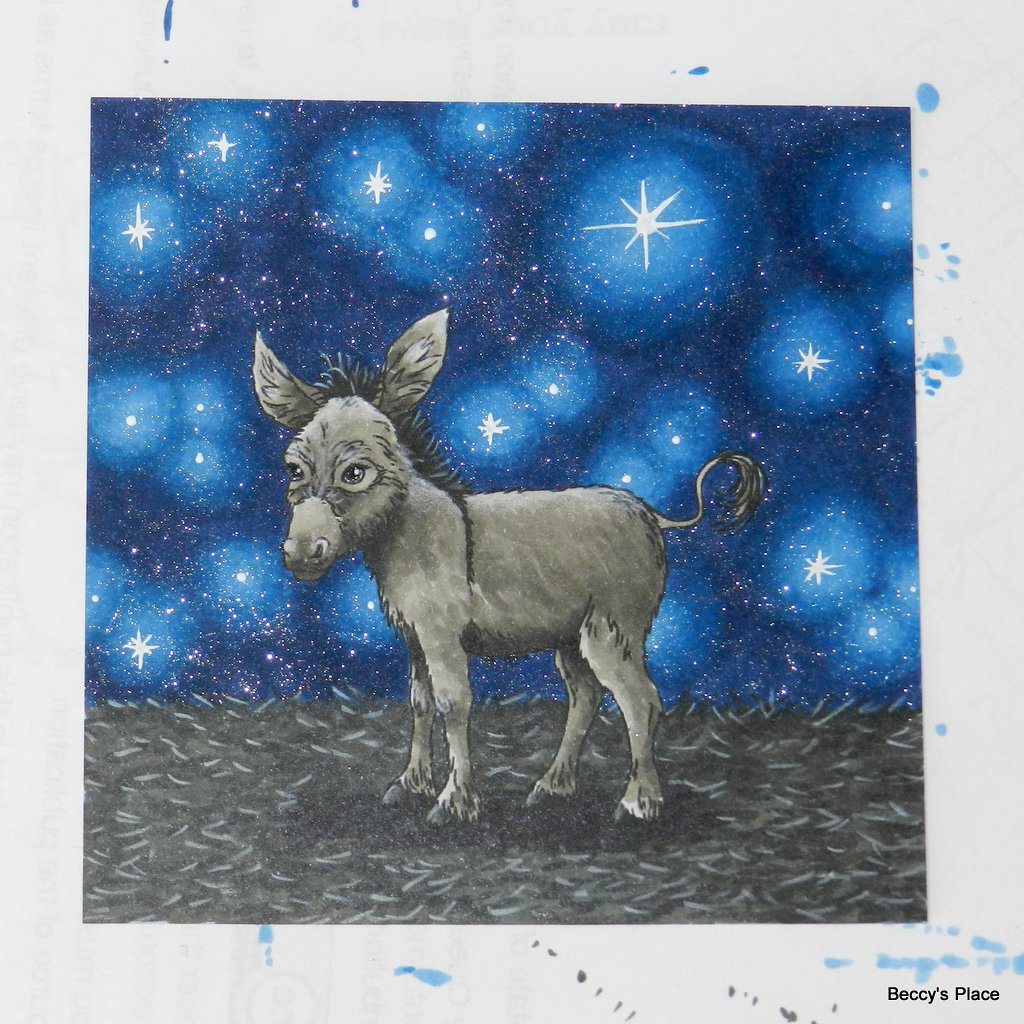
A night sky filled with stars is the perfect backdrop for my little donkey, and today I want to show you how to achieve this look using Copic markers on blending card.

I started by colouring the donkey using various shades of warm grey, from W2 up to W7. If you're not feeling overly confident with colouring the focal image, you can print a coloured version on your blending card and focus instead on the background.


I used B45 to colour the entire background. At this stage, I'm not worried about the streaky lines created by the pen, as they will start to disappear as further layers are added. I tend to use the wide end when colouring large areas and the brush end when working close to the focal image.


Using B37, I've plotted out the positions of each star, as well as the ground where the donkey is standing, with a simple dotted line. Make the circles quite large as this will be the area that "glows" around each star. Don't forget to add some partial circles behind your focal image and off the edges of your cardstock. This gives the design continuity.


Now use the B37 marker to colour around each circle. As you can see, with just the addition of one extra layer of colour, those streaky lines are already starting to disappear.


Come back in with the B45 and colour over the edge of each circle - we're beginning the blend between the B45 and the B37. Don't worry that there's still an obvious line between the two shades... we'll continue to work on that as we go. Don't be tempted to overwork the colours or you'll end up breaking up the pigment resulting in a mottled effect.


Using a B39 marker, we're going to mark larger circles around our stars in the same manner we did before. As you can see from my picture, some of the circles will start to converge, which is perfectly fine. Just keep the circles even and don't add the darker colour inside the lighter areas.


Colour with the B39 marker right up to the dotted lines you drew in the previous step. Don't try to make the borders between each colour nice and straight and clean, you'll get a better blend if you keep them a little messy. 


Now we're going to get serious about our blending, and from this point on, you want to try and work in a circular motion around each star. Using only the three markers we've already coloured with, we're going to colour each area again, overlapping the colours slightly. Start with the B45 and colour from the very centre of each circle to about halfway through the B37. Now switch to the B37 and colour from slightly outside the first dotted line, which will be a little over the area you just coloured, out to just over the second dotted line. Finish by using the B39 from slightly outside the second dotted line to slightly outside the second dotted line of neighbouring stars.


I find it easiest to work each star one at a time until the blend is nice and smooth. If things are still a little streaky, repeat the process again until you're happy with the result. 


The next step is to colour the straw beneath the donkey's feet. Since it's nighttime, all the colours will be toned and dark, so we're going to be working with our warm greys again. Use a W8 marker to stroke in some short lines going in all different directions and crossing over each other haphazardly.  Don't lay the strokes all in the same direction or the texture won't look right.


Use a W9 marker to add more strokes over the first ones. You don't want quite as many as the W8, so just aim for the spaces you missed the first time around.


Now with a W10 marker, use very small strokes to fill any remaining spaces. This extra dark colour will give further depth and texture to the straw.


Add a shadow beneath the donkey using the 100 marker. Don't colour a solid shape, rather stroke in short patches in the same way you did the straw. It's okay to leave a few small spaces between strokes.


I used the W8, W9 and W10 to deepen all the shadows on the donkey, particularly the underside of its chin and belly, and in the ears. To get the effect of bright white starlight shining down, apply a light coat of white pencil to the high areas of the donkey - it's back, tips of the ears and top of the nose. Stroke in some white pencil on random areas of the straw too... just don't go overboard!


I covered the entire sky with a clear coat of Wink of Stella. It's subtle enough not to overpower the image as glitter might, while still giving the effect of a sky full of tiny pinpricks of light.


Use a white gel pen to add a dot in the very centre of each circle you coloured. Vary the size of the dots depending on how large the circle is. If you wish, you can drag the white pen out from the centre to give the effect of star beams.


Take a moment to look carefully at your scene. Decide if the shadows are deep enough to contrast with the night sky, and don't be afraid to add a little extra if you think it necessary. Have fun!


Stamps: